You walk into a room and something feels off. The furniture is fine. The colours look nice. But the room feels heavy, or cold, or restless.
In classical Chinese philosophy, this has an explanation. Every space has a balance — or an imbalance — of five types of energy. They call them the Five Elements.
This is not decoration theory. It is a system that has been used for over 2,000 years.
What Are the Five Elements?
The Five Elements are not physical materials. They are categories of energy. Each one has qualities — a direction, a season, a colour, a type of movement.
Wood is growth. It is the energy of spring — things beginning, pushing upward. Direction: East and Southeast. Colours: green, light brown. Shapes: tall and narrow. In a home: plants, wooden furniture, columns.
Fire is expansion. It is summer energy — bright, warm, active. Direction: South. Colours: red, orange, strong pink. Shapes: triangles, pointed. In a home: candles, fireplaces, bright lights.
Earth is stability. It is the energy between seasons — grounding, slow, reliable. Direction: Centre, Southwest, Northeast. Colours: yellow, beige, terracotta. Shapes: flat and square. In a home: ceramic, stone, low heavy furniture.
Metal is precision. It is autumn energy — things contracting, becoming clear and defined. Direction: West and Northwest. Colours: white, grey, gold, silver. Shapes: round and oval. In a home: metal objects, white walls, circular mirrors.
Water is flow. It is winter energy — deep, quiet, moving. Direction: North. Colours: black, dark blue, navy. Shapes: wavy and irregular. In a home: water features, glass, mirrors, dark colours.
How the Elements Work Together
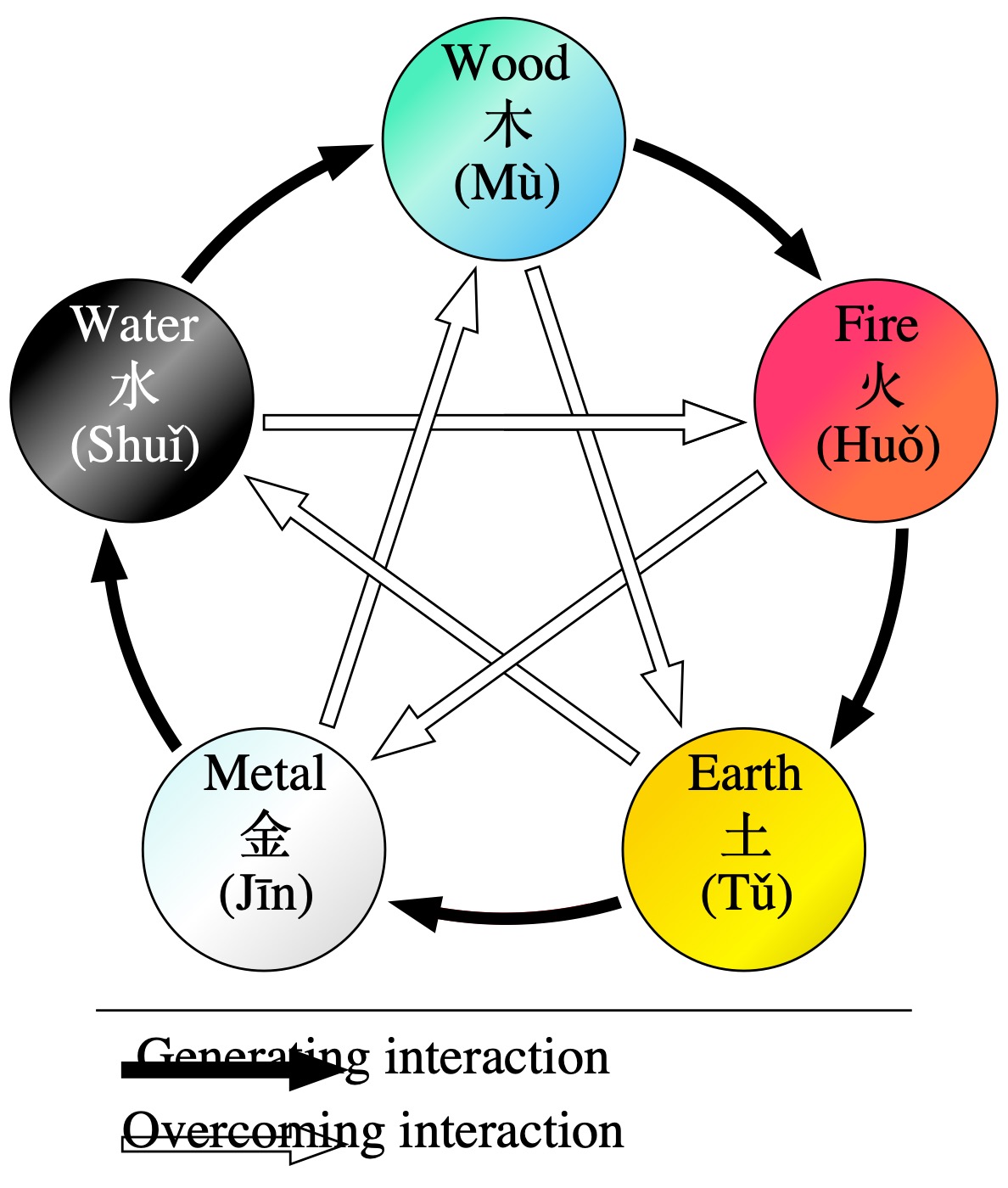
The five elements are not separate. They interact. There are two important cycles to know.
The Productive Cycle: each element helps the next one.
Wood feeds Fire. Fire makes Earth (ash). Earth contains Metal. Metal produces Water. Water feeds Wood.
This is the cycle of support. If a room feels flat, it may be missing an element that feeds it.
The Controlling Cycle: each element also controls another.
Wood controls Earth (roots break soil). Earth controls Water (a dam). Water controls Fire. Fire controls Metal (melts it). Metal controls Wood (an axe).
This is useful when you have too much of one element. You add its controller to reduce it.
What This Looks Like in a Real Home
A living room that feels anxious and restless. People argue there. Nobody relaxes.
A practitioner looks at the room and sees: too much Fire (red sofa, fireplace, bright rug, angular furniture) and almost no Earth. Earth calms Fire. The fix: add a terracotta pot, a square stone table, beige cushions. The room becomes calmer.
A bedroom that feels cold and empty, even with heating on. Often this means too much Metal or Water and not enough Wood or Fire. Add a plant. Change the bedding to a warm colour. The room changes.
The Most Common Mistake
People pick a colour they love and use it everywhere. All white. All grey. All dark wood.
Too much of any one element creates imbalance. An all-white home (Metal) can feel sterile and cold. An all-wooden home (Wood) can feel pressured. An all-dark home (Water) can feel heavy.
Balance does not mean equal amounts of everything. It means each element is present — some more than others, depending on the room and the direction it faces.
How to Use This in Your Home
Start with one room. Stand in the centre and look around. What do you see a lot of? What is missing?
Then check the direction the room faces. Each direction has a natural element:
North → Water · South → Fire · East / SE → Wood · West / NW → Metal · Centre / NE / SW → Earth
A North-facing room already has Water energy. You probably do not need more dark colours or a water feature. You might need Wood (plants) to balance it.
The IV Sanctuary app tells you the element of each sector in your specific home, combined with your personal Kua number. It gives you a direction-by-direction picture — not generic advice.